Accepting new studies — 2 slots left this month OpenFOAM · PhD · Q1 journals

Know the answer before you build it.

PhD-level CFD for flow, heat transfer and multiphase problems — validated against experiments, built on open-source OpenFOAM. You get trustworthy numbers, a clear report and every case file. No licence fees. No black boxes.

Reply within 24 h NDA before any file Fixed-price quote
SCROLL
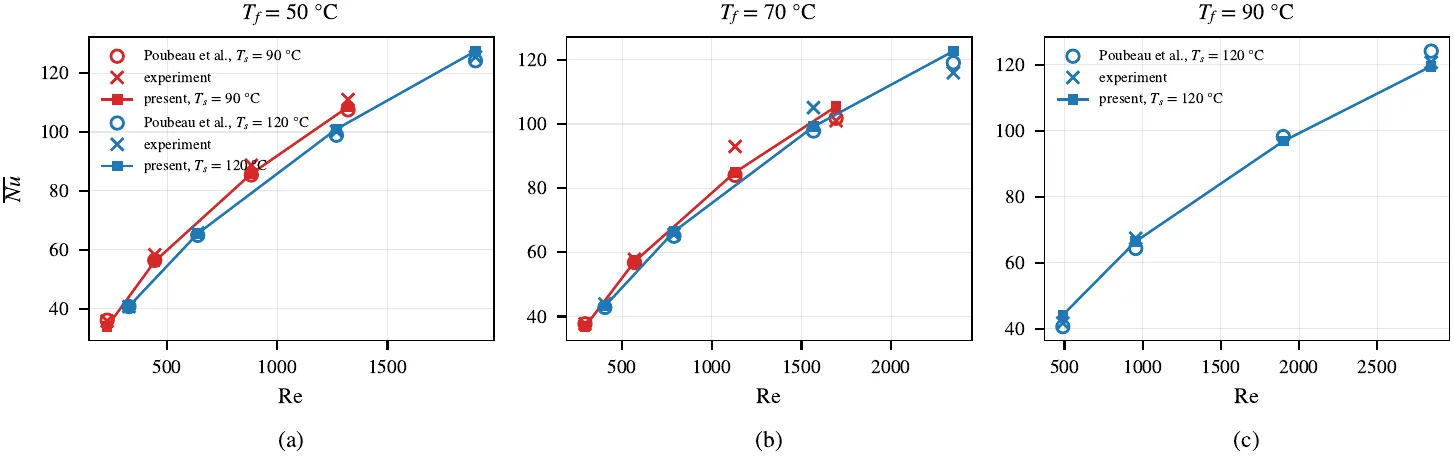
3.0 %mean deviation from experiments (Nusselt, 20 oil jets)
7journal & conference papers — 4 in Q1 journals
11open case studies with images & video
0 €software licence fees passed on to you
Experience at IFPENISAE-ENSMAENEADHanoi Univ. of Science & Tech.ICTU
Why clients call

A failed prototype costs more than a simulation.

Every build–test–fail loop burns weeks and tens of thousands of dollars. A good simulation shows you what will happen — and why — before you cut metal.

“Our motor overheats at peak load and we can’t see where the hot spot is.”

→ Two-phase oil + conjugate heat transfer shows which winding zones stay dry and where to put the nozzles.

“The fire authority wants proof that our car park stays tenable in a fire.”

→ 3-D smoke & heat simulation with your real jet fans, with time-resolved tenability at every escape route.

“If a landslide hits the reservoir, will the wave overtop the dam?”

→ Terrain-to-CFD model from satellite data: wave speed, water level at the dam, affected zones.

Featured work

Real results. Real validation.

All projects →
What we simulate

The hard physics that push-button tools skip.

Thermal management & e-mobility

Oil-cooled e-motors, battery cold plates, water jackets, power electronics, data-centre liquid cooling.

Multiphase & free-surface

VOF, sprays and films, dynamic wetting, sloshing, waves, spillways — with adaptive mesh refinement.

Fire, smoke & ventilation

Car parks, tunnels, high-rise and battery storage; HVAC and indoor thermal comfort.

Floods & natural hazards

Dam break, landslide-generated waves, urban flooding — from public terrain data to 3-D models.

Design optimisation

Automated DAKOTA + OpenFOAM loops: hundreds of geometry variants, the best one picked for you.

Custom solvers & training

New OpenFOAM solvers for your physics; hands-on training so your team can run them.

How it works

Clear from day one. No surprises.

You know the scope, price and deadline up front — and you see progress all the way.

Free feasibility review

You describe the problem. We tell you if CFD can answer it, how, and with what accuracy.

≤ 24 h · free

Fixed-price proposal

Scope, physics models, validation plan, milestones and a fixed price. NDA signed if needed.

2–5 days

Simulate & validate

Geometry, mesh, mesh-independence, comparison with experiments or benchmarks. Weekly updates.

2–6 weeks

Deliver & support

Report, images, videos and the complete OpenFOAM case you can re-run. 30 days of follow-up questions.

you own everything
Why open source

Results you can inspect, re-run and own.

OpenFOAM is used across the automotive, aerospace and energy industries. The difference is never the software — it is knowing which numbers to trust.

  • No five-figure annual licence in your quote
  • We change the algorithm when your physics is not built in
  • Open case files — your team can re-run new variants
  • No vendor lock-in, ever
Compare your options →
Validation: Nusselt number vs Reynolds number against experiments
VQ
Who does the work

Dr. Van Quan Hoang

PhD in Mechanics & Energy (ISAE-ENSMA, France). Former R&I engineer at IFPEN and R&D manager at ENEAD, France. Author of a two-phase conjugate heat transfer solver for e-motor cooling. You work directly with the expert — no account managers, no hand-off to juniors.

More from the lab

Open code, open results.

Every public study here is free to learn from. The library grows every month.

FAQ

Before you ask.

Is OpenFOAM as accurate as Ansys Fluent or STAR-CCM+?

Accuracy comes from the physics models, mesh quality and validation — not from the software brand. Every study includes a mesh-independence check and a comparison with experiments or reference solutions; for example, our oil-jet solver is within 3.0 % of 20 experiments.

Is my geometry and data kept confidential?

Yes. We sign an NDA before receiving any file. Client projects are never published without written permission.

What do I need to provide?

A short description and the question you want answered is enough to start. Later: CAD (STEP/STL), operating conditions, material properties and any measured data you have.

How much does it cost?

Every study gets a fixed price after the free review. A typical study costs less than one prototype iteration — and far less than one year of a commercial CFD licence.

How long does it take?

Feasibility review: 24 h. Standard study: 2–6 weeks depending on complexity. Express timelines are possible.

Do you work with international clients?

Yes. We work in English, French and Vietnamese, remotely, with clients in any time zone.

Next step

Tell us your problem.
Get an honest answer in 24 hours.

The feasibility review is free and carries no obligation. If CFD is not the right tool for you, we will tell you so.

We take a limited number of studies each month to keep quality high.